


Addiction Treatment and the Multiple Echoes of History: Lessons to Heed

January 12, 2026
William Stauffer, LSW, Author and Executive Director, Pennsylvania Recovery Organizations Alliance (PRO-A)
Tom O'Connor, Publisher
With respect to efforts to expand addiction recovery in America, our new challenges often have historic parallels. It is also true that some of the most effective ideas we can harness to advance our endeavors have roots in eras well before our own. In this way, rarely are things new under the sun. These dynamics were very much on my mind when I came across William White's 1999 piece, "The Collapse of 19th-Century Addiction Treatment: Could It Happen Again?"
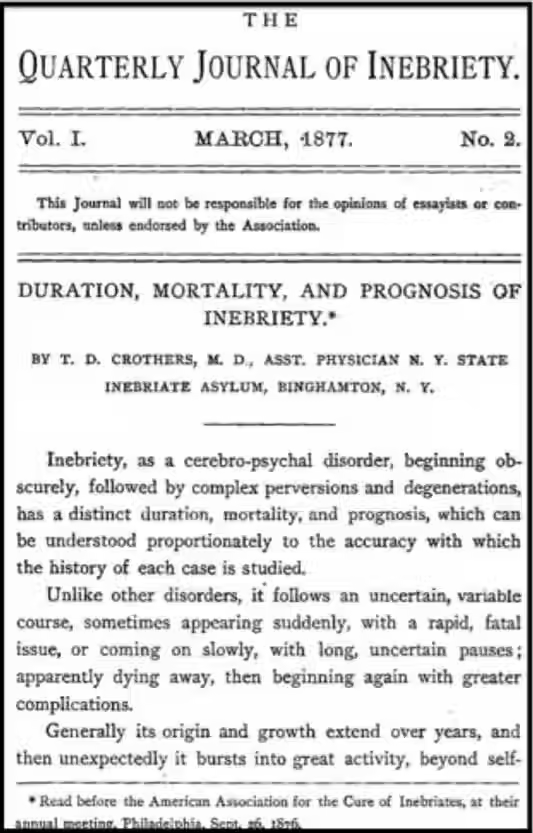
The infrastructure he was describing was the first system of care in the US, comprised of programs for inebriates, the term at that time for persons with alcohol addiction, including recovery homes, asylums, private addiction treatment programs, and home cures. These programs rose between 1850 and 1900. There was even the first addiction periodical, the Journal of Inebriety, which began publication in 1876.
For interested readers, these journals are available for addiction and recovery scholars in the Hazelden Pittman Archives at Hazelden Betty Ford's Addiction Research Library in Center City, MN. It is a national treasure for our field. William White has also preserved the journal's table of contents, available here.
There is much for us to learn through examination of this and later attempts to support healing from substance use conditions in an organized fashion.
Perhaps most importantly, it is readily apparent that we grapple with very similar challenges 200 years later. The song remains very much the same across the ages. We could learn from our history, but only if we pay attention to it. Even a casual examination of the history of that era that rose in the 19th century with respect to addiction and recovery would reveal what one could consider a free-for-all. An ecosystem ripe for fraud and abuse at the expense of the vulnerable. Wild, baseless claims about cures, elixirs promising relief, containing alcohol, cocaine, and opioids.
Expensive treatments, catered to the wealthy and overpromised what they could accomplish while profiting off the suffering of thousands of people. People who were desperate to try anything at any price to escape the ravages of addiction. The inevitable scandals led to a profound loss of public trust and an erosion in belief that people with substance use conditions were even worth helping.
Hustlers and Huskers
It may have been the first time we had seen this cycle of harm in the name of help hawked by an army of hustlers and hucksters, but it was far from the last.
Dynamics I started to write about in a similar context, with heavy reliance on the seminal work of William White, in two pieces:
The Devolution of PRSS and the Lost Lessons of Earlier Eras in September of 2024. As noted by White, in this paper, the rise of the first addiction field in the 19th century corresponded with an increase in addiction to alcohol and other drugs, broadly referred to in that era as narcotics.
The very first iteration of the addiction treatment field went through a boom and then a bust. He cites multiple factors in the collapse of that system, including:
An economic downturn that reduced financial support for the efforts weakened the field's capacity to address internal and external challenges to forward progress constructively.
A culture shifted away from viewing these conditions as treatable in the broader public sphere, in no small part due to the excesses of the fledgling field.
A focus on viewing addictions from a moral lens and a shift to the criminalization of addiction and legal sanction.
When William White wrote the paper in 1999, he identified several parallel challenges in our field. A sea change was occurring in orientation, funding, and support for recovery, driven by both internal and external forces.
What he wrote about in this context in the late 1990s included:
The impact of managed care in both the public and private sectors has resulted in dramatically reduced access to care.
The shift in focus from healing to criminal justice-oriented interventions became the primary focus in the 1980s and 1990s, moving away from healing as its core function.
Ethical concerns are internal to our field, to our workforce, and to peripheral systems that erode public support for treatment efforts.
The loss of connection to community, as overprofessionalization and institutionalization of the field undermined the vitality of community-grounded support that often grew organically, making it both robust and brittle.
A system with minimal infrastructure and high workforce turnover, in part as a result of these cumulative challenges.
William White saw in our care ecosystem weak, fragmented institutions without a cohesive focus on healing. A service system that lacked connection to the authentic community, resting on a shallow foundation with a minimal body of evidence to support its claims or to guide its progress forward. He saw profiteering and a focus on the wealthy that largely ignored the needs of lower-income groups.
It lacked mechanisms for long-term follow-up to support the development and delivery of services throughout the healing process beyond acute, short-term treatment. He noted a dearth of state personnel to steer efforts in the direction they needed to move, and anemic programs and systems vulnerable to colonization by external interest groups.
In light of the challenges he identified, he noted what would be needed to correct course, avoid a collapse, and sustain efforts. He penned: "To prevent such a scenario, we must rebirth the grass roots movement that laid the cultural foundation for the rise of 20th-century addiction medicine and the modern system of addiction treatment. We must both aggressively monitor the ecosystem in which we operate and take a more activist role within it. We must recenter ourselves clinically and ethically. We must take a highly splintered field and find a way to speak with one voice. And we must rebirth a new generation of leaders who can carry our mission of serving the still suffering addict into the 21st century. If we fail to meet these challenges, we may be doomed to repeat an episode in history little known to today's providers of addiction treatment. And that lack of knowledge is perhaps itself a source of great vulnerability."
As the great comedic scholar Lilly Tomlin once suggested, "Maybe if we listened, history wouldn't keep repeating itself." We have made limited progress in the direction he prescribed, in no small part because we initially focused broadly on grassroots, authentically driven goals while setting aside our differences and keeping our collective eyes on the prize. Yet now, at this moment in history:
• We have lost mainly that forward momentum and lack a cohesive, broadly agreed-upon focus of efforts.
Much of the work we accomplished through collective effort has eroded as the vision of community-driven efforts has become just another profit center for industries at the expense of the vulnerable.
There are a myriad of drugs being marketed in vape shops and elsewhere to people with addictions in ways that cause harm in the name of help, not dissimilar to what occurred in the patent medication era of the 19th century.
We have a workforce facing immense barriers that prevent them from actually helping people. They work for dismally low wages, mired in red tape, and care is cut too short to be effective. So, they quit. We simply cannot sustain forward momentum without a seasoned and capable workforce, yet turnover rates have never been higher.
We are further away from universally agreed-upon definitions of the pathology and healing from a substance use condition than a generation ago, even as the proliferation of definitions became a cottage industry.
We have funding, credentialing, and governance systems rife with profound conflicts of interest.
Ethical conduct beyond the individual, at the institutional level of funders and service providers, has never been promulgated; sanctions, more properly leveled at how our systems operate, focus instead on a few bad apples that are actually in rotten barrels, that we ignore in emperor 's-new-clothes fashion.
We are experiencing a gold rush as treatment is increasingly the focus of venture capitalists and disruptors, more focused on profit than on helping people heal. Peer services have become a veritable cash cow for those seeking to bill Medicaid and private insurance and to maximize revenue for services originally intended to be grounded in community bridging and recovery, as well as in community capital building.
Efforts intended to be nestled within the community, not simply another profit center for recovery capitalists, have become exactly that. We are at our best when we are grounded in strong ethical values and focused on community-oriented service, and at our worst when our systems are oriented toward short-term financial incentives for a few while gatekeeping broader community-oriented healing strategies, which is the trend now. In consideration, we need to balance the interests of a profit-oriented industry with community-grounded service values.
As often happens when I think I have had an original thought, I stumble upon this, which William White wrote in 2002: "Addiction counseling in the modern era has been practiced as an essentially clinical activity, but this has not always been the case. There have been key points in the history of addiction treatment when the functions of community organization and social activism competed with, or complemented, this clinical orientation... It is argued that the professionalization (medicalization and psychologization) of addiction treatment needs to be balanced by a re-emphasis on recovery as a connection with indigenous resources and relationships beyond the self."
The New Recovery Advocacy Movement emerged a generation ago through grassroots efforts by community members, and much of their vision for what we could achieve has been lost. Without a community-grounded vision, it is devolving into just another industry oriented on narrow goals.
Are we facing a collapse, or at a minimum, a significant retraction of our efforts as we lose our way?
We should ask ourselves:
What are the organizing concepts with respect to addiction care and recovery support that are broadly agreed upon by all stakeholder groups and community members in our own era?
What efforts are we undertaking to strengthen ethical conduct standards, not only at the individual level but across all our related institutions?
How much of what is occurring now authentically involves the recovery community in all of its diversity?
Where are our state people who help drive these efforts forward? What do we want written about our era of history 25 years from now, and what are we doing to make sure that is the version that unfolds?
William Stauffer holds a Master of Social Work (MSW) degree and serves as the executive director of the Pennsylvania Recovery Organizations Alliance and as an adjunct faculty member at Misericordia University. He can be contacted at billstauffer@rcn.com.uffer@rcn.com.
If you enjoyed this article,
Please forward this to a friend or colleague who might benefit from it!


Comments